
Generative AI is rapidly changing the way people work, learn, develop software, create content, and solve business problems. From AI-powered chatbots and image generators to intelligent agents and automated applications, generative AI is becoming an important technology across industries.
For anyone interested in entering the AI field, learning how generative AI works is a valuable starting point. However, choosing the right learning resources can be challenging, especially for beginners who are unsure whether to start with machine learning fundamentals, large language models (LLMs), prompt engineering, or practical AI development.
Fortunately, several well-known technology companies, universities, and AI experts offer structured learning resources that can help learners understand these technologies.
In this article, we explore five useful generative AI courses and learning resources from Microsoft, Andrej Karpathy, Google, Coursera, and DeepLearning.AI.
These resources cover everything from basic AI concepts to neural networks, LLM development, and practical generative AI applications.
1. Generative AI for Beginners – Microsoft
Generative AI for Beginners
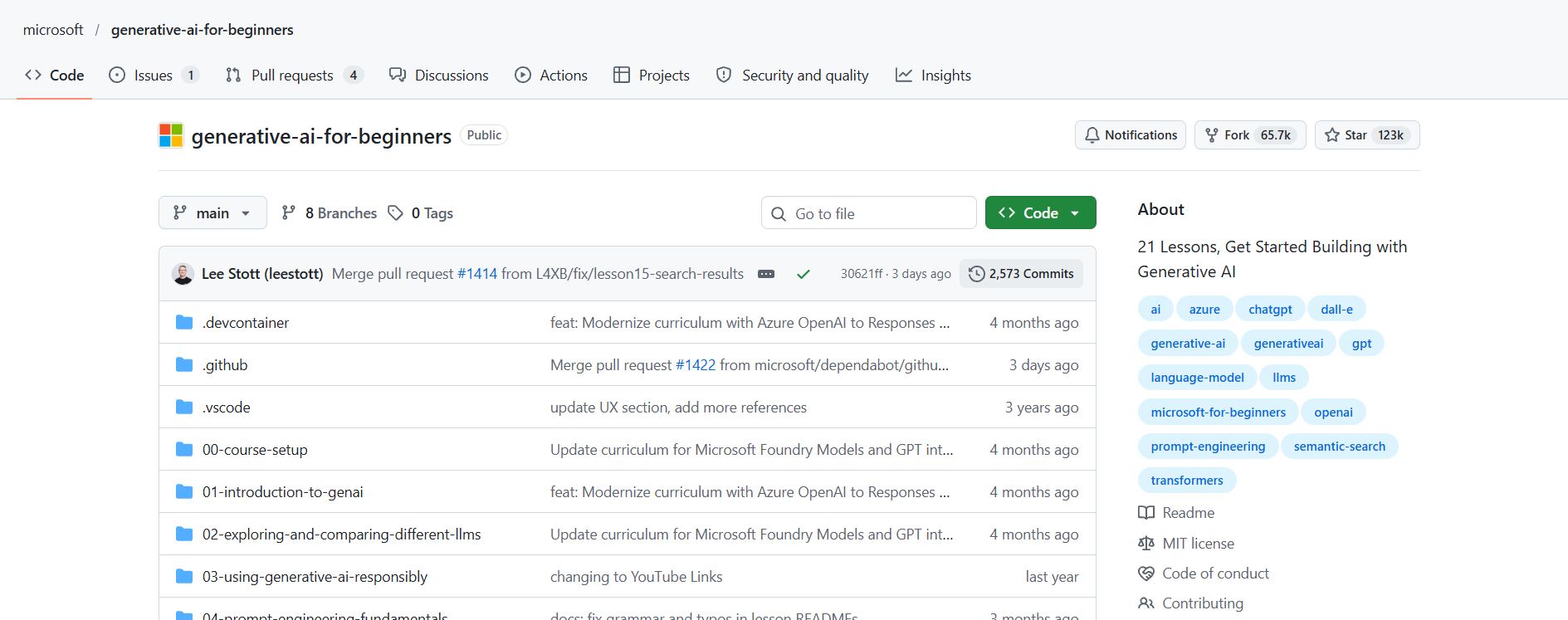
Microsoft’s Generative AI for Beginners is a comprehensive learning resource designed to help developers understand generative AI concepts and build applications using modern AI technologies.
The course contains 21 lessons divided between theoretical explanations and practical development exercises. It is particularly useful for learners who want to move beyond simply using AI chatbots and start developing their own AI-powered applications.
What you will learn:
- Introduction to generative AI and large language models.
- Comparing different LLMs and understanding their capabilities.
- Responsible AI principles and application security.
- Prompt engineering and advanced prompting techniques.
- Building text-generation and chatbot applications.
- Working with embeddings and vector databases.
- Image generation and function calling.
- Retrieval-Augmented Generation (RAG).
- AI agents, fine-tuning, and small language models.
- Working with open-source models.
The course includes written lessons, video introductions, and code examples in Python and TypeScript where applicable. It also supports multiple languages, making it accessible to learners worldwide.
Who should take this course?
This course is particularly suitable for beginner-to-intermediate developers, software engineers, and students who want practical experience building generative AI applications.
2. Neural Networks: Zero to Hero – Andrej Karpathy
Neural Networks: Zero to Hero
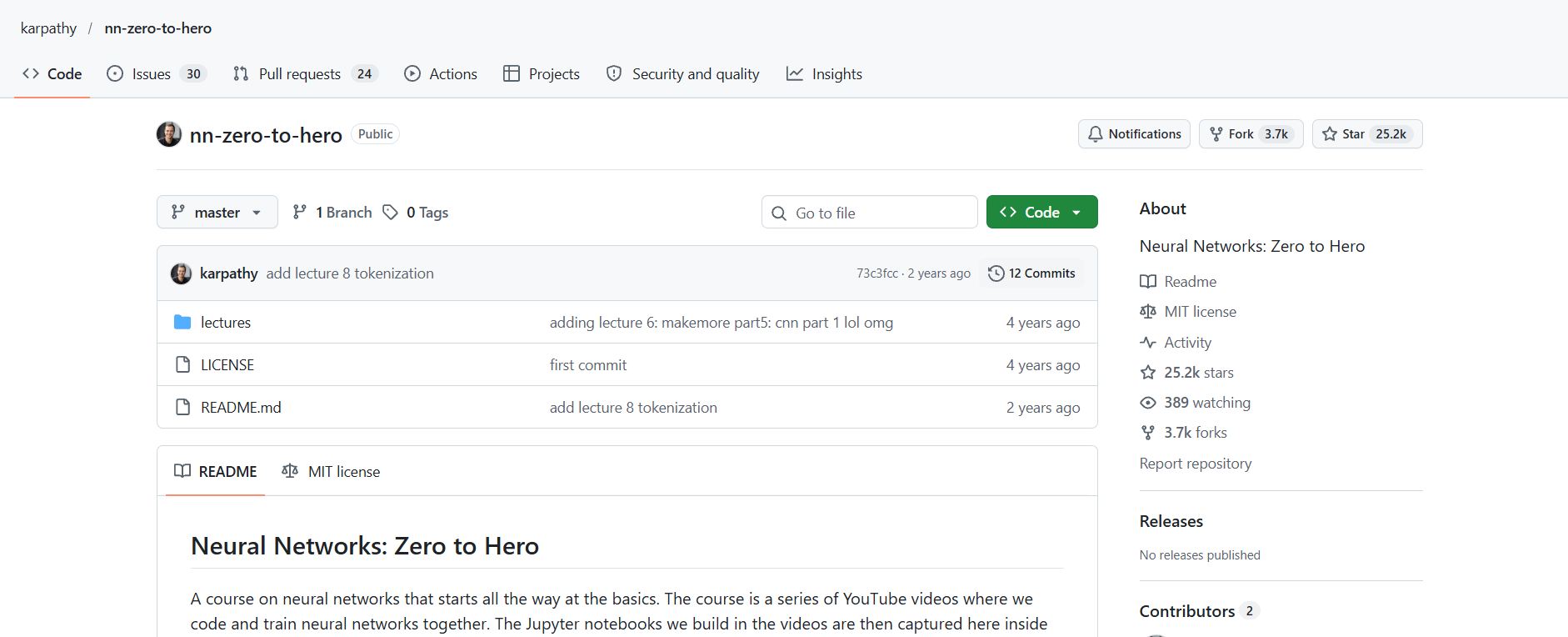
If you want to understand what happens inside neural networks rather than simply using existing AI models, Andrej Karpathy’s Neural Networks: Zero to Hero is an excellent resource.
Andrej Karpathy, an AI researcher and former Director of AI at Tesla, created this educational series to explain neural networks through practical coding exercises and detailed video lectures.
Unlike courses that focus primarily on using existing AI tools, this series teaches learners how neural networks work internally, starting with fundamental mathematical concepts and gradually progressing towards GPT-style language models.
What you will learn:
- Fundamentals of neural networks.
- Backpropagation and gradient descent.
- Building a basic automatic differentiation engine using micrograd.
- Language modelling using character-level prediction.
- Multilayer perceptrons (MLPs).
- Activation functions and gradients.
- Batch normalization.
- Training and evaluating neural networks.
- Building Transformer-based language models.
- Understanding the architecture behind GPT.
The course provides YouTube lectures, Jupyter notebooks, GitHub repositories, and exercises. Learners can follow along with the instructor and implement the concepts themselves.
Who should take this course?
This resource is particularly useful for Python developers, computer science students, machine learning enthusiasts, and anyone interested in understanding deep learning at a technical level.
Some basic Python programming knowledge and introductory mathematics, including derivatives, are recommended.
Why is it worth learning?
Understanding neural networks provides a stronger foundation for working with LLMs, deep learning architectures, and modern AI systems. It is especially valuable if your long-term goal is to develop or train AI models rather than only integrate existing APIs.
3. Introduction to Generative AI – Google Skills
Introduction to Generative AI
Explore the Google learning path
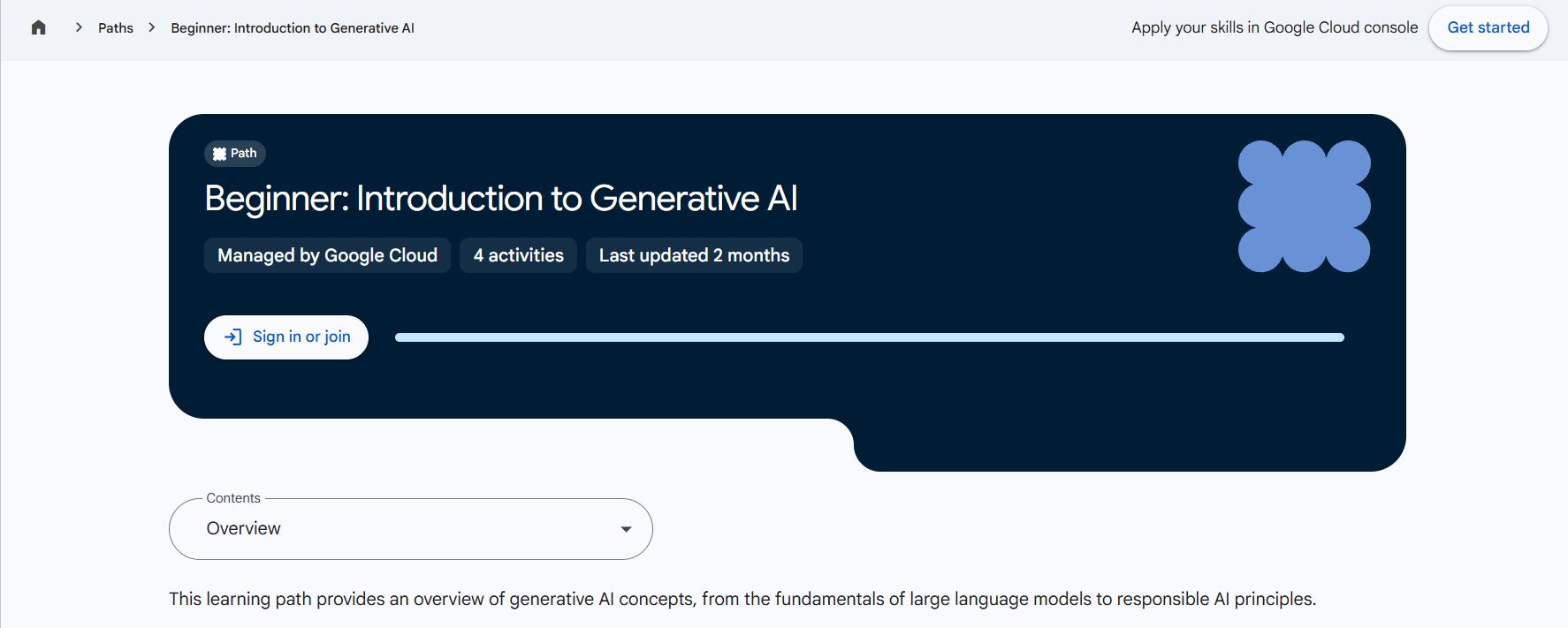
Google Cloud offers a beginner-friendly learning path called Introduction to Generative AI through its Google Skills platform.
This learning path is designed for people who want to understand generative AI without immediately getting into complex programming or mathematical concepts.
It provides an overview of how generative AI works, what large language models are, and how responsible AI principles should be considered when using these technologies.
What you will learn:
- Introduction to generative AI.
- Fundamentals of large language models.
- How generative AI technologies work.
- Important AI concepts and terminology.
- Responsible AI principles.
- Understanding the capabilities and limitations of generative AI.
The learning path currently lists four learning activities and is managed by Google Cloud. Its official page also indicates that it has received recent updates.
Who should take this course?
This is a good starting point for students, beginners, business professionals, non-technical users, and anyone who wants to develop a basic understanding of generative AI.
Why is it worth learning?
Google’s learning path provides a structured introduction to the subject without requiring learners to begin with advanced programming. It is a suitable first step before moving towards practical AI development and advanced LLM courses.
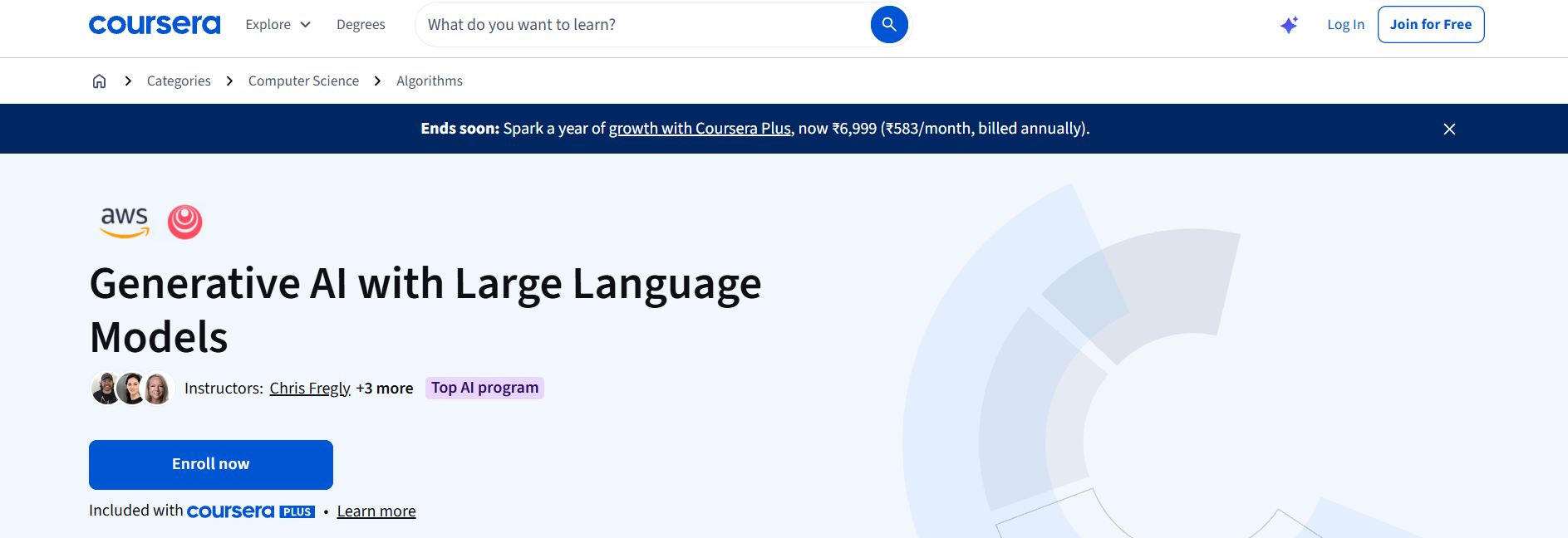
4. Generative AI with Large Language Models – Coursera
Generative AI with Large Language Models
For learners who already have some programming and machine learning experience, Generative AI with Large Language Models is a more technically focused course.
Offered by DeepLearning.AI in collaboration with Amazon Web Services (AWS) on Coursera, this course explains how large language models are developed, trained, fine-tuned, evaluated, and deployed.
It goes beyond basic prompting and introduces the technical processes involved in building and optimizing LLM-powered applications.
What you will learn:
- Generative AI use cases and applications.
- Transformer architecture and how LLMs work.
- Pre-training large language models.
- Computational challenges and scaling laws.
- Prompt engineering and generative configurations.
- Fine-tuning language models.
- Parameter-efficient fine-tuning techniques such as LoRA.
- Model evaluation and benchmarking.
- Reinforcement Learning from Human Feedback (RLHF).
- LLM deployment and optimization.
- Responsible AI and LLM-powered applications.
The course is divided into three modules:
- Week 1 – Generative AI, LLM architecture, pre-training and scaling
- Week 2 – Fine-tuning, model evaluation and LoRA
- Week 3 – RLHF, deployment, optimization and responsible AI
It includes video lectures, readings, quizzes, and practical laboratory exercises.
Who should take this course?
This course is best suited for developers, Python programmers, machine learning engineers, data scientists, and students who already understand basic machine learning concepts.
Basic Python experience is recommended, along with familiarity with supervised and unsupervised learning, loss functions, and training and testing datasets.
Course duration and access:
Coursera estimates approximately two weeks at 10 hours per week, although learners can study at their own pace. Access to graded assignments and certificates depends on the enrollment option. Eligible learners may have access to a free trial or other course-access options.
Why is it worth learning?
If you want to understand the complete LLM development lifecycle, including pre-training, fine-tuning, evaluation, and deployment, this course offers a more technical learning experience than general introductory AI courses.
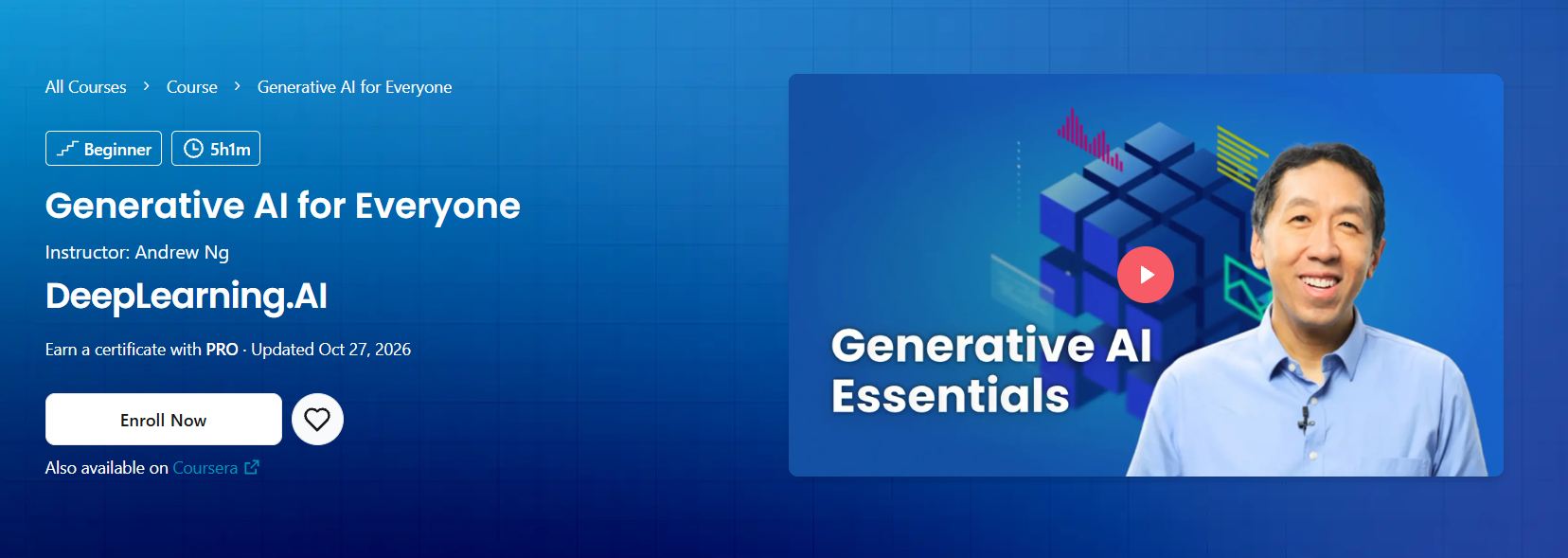
5. Generative AI for Everyone – Andrew Ng (DeepLearning.AI)
Generative AI for Everyone
Generative AI for Everyone is an introductory course taught by Andrew Ng, a well-known AI researcher, educator, and founder of DeepLearning.AI.
The course is designed to make generative AI understandable to a broad audience, including people without programming or technical backgrounds.
Rather than concentrating on model development, it explains the technology, its practical applications, its limitations, and its impact on businesses and society.
What you will learn:
- What generative AI is and how it works.
- What large language models can and cannot do.
- Real-world generative AI applications.
- How to use generative AI tools effectively.
- Prompt engineering fundamentals.
- AI applications in everyday work.
- Generative AI projects and business opportunities.
- The impact of AI on businesses and society.
- How to think about AI strategy and productivity.
The course is organized into three main weeks:
- Week 1 – Introduction to Generative AI
- Week 2 – Generative AI Projects
- Week 3 – Generative AI in Business and Society
The official course page currently lists approximately five hours of content, 32 video lessons, two code examples, and six graded assignments available through the relevant Pro offering.
Who should take this course?
This course is suitable for:
- Students and beginners.
- Business owners and entrepreneurs.
- Marketing professionals.
- Managers and team leaders.
- Working professionals.
- Anyone interested in understanding AI.
Do you need programming knowledge?
No. The course does not require previous AI knowledge or coding skills.
Why is it worth learning?
Andrew Ng explains complex AI concepts in an accessible way, making this a useful resource for people who want to understand how generative AI can improve productivity, support business decisions, and create new opportunities.
Note: These are learning-resource recommendations, not a ranking. Availability of certificates, labs, and course materials may vary by platform and enrollment option.
If you are completely new to generative AI, jumping directly into advanced LLM development may feel overwhelming. A structured learning approach can help you build the necessary knowledge gradually.
Your Generative AI learning journey
Step 1: Understand AI fundamentals
Start with Google’s Introduction to Generative AI or Andrew Ng’s Generative AI for Everyone.
Step 2: Understand neural networks
Study Andrej Karpathy’s Neural Networks: Zero to Hero to understand backpropagation, neural networks, and Transformers.
Step 3: Learn practical generative AI development
Follow Microsoft’s 21-lesson course and start building AI-powered applications using Python or TypeScript.
Step 4: Explore advanced LLM concepts
Take the Coursera course to understand model training, fine-tuning, evaluation, and deployment.
Step 5: Build real-world AI projects
Develop chatbots, document assistants, RAG applications, AI agents, and automation tools.
Final Thoughts
Generative AI is much more than interacting with chatbots. It involves understanding machine learning, neural networks, language models, data processing, model training, and application development.
The five learning resources covered in this article provide different entry points into the field.
Our recommendation: Do not limit your learning to watching videos or completing courses. Build small projects, experiment with different models, understand their limitations, and gradually develop more advanced AI applications.
Practical experience combined with a strong theoretical foundation will help you develop valuable generative AI skills.