
The demand for full-stack developers has skyrocketed in recent years, and one of the most powerful technology combinations dominating the software development industry today is the MERN Stack.
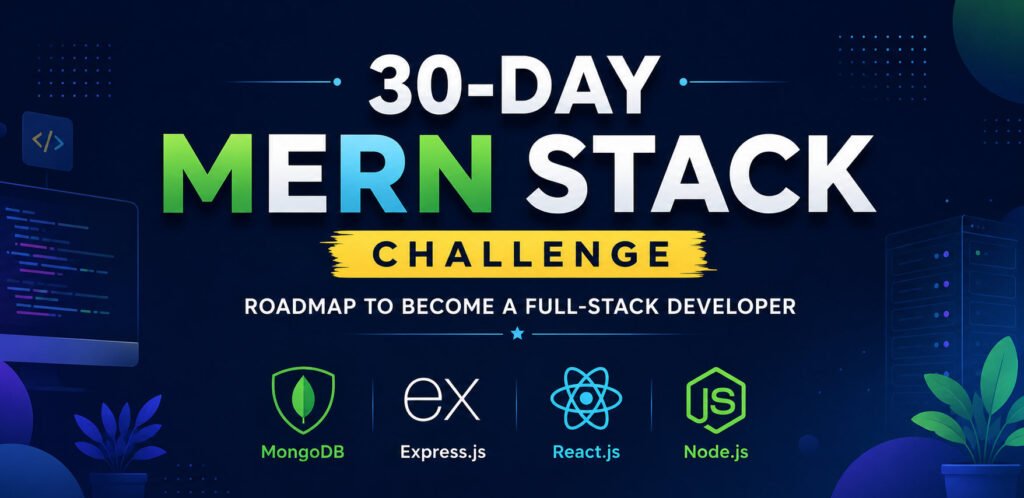
The MERN Stack consists of:
- MongoDB for Database (MongoDB is a NoSQL database used to store application data in flexible JSON-like documents.)
- Express.js for Backend framework (Express.js is a lightweight backend framework for Node.js used to create APIs and handle server-side logic.)
- React.js for Frontend library (React is a JavaScript library developed by Meta for building interactive user interfaces.)
- Node.js for JavaScript runtime (Node.js allows JavaScript to run on the server side.)
What makes MERN stack incredibly popular is the ability to use JavaScript across the entire development process, from frontend to backend. This reduces complexity, speeds up development, and makes it easier for all developers to build scalable and modern applications.
The “30-Day Challenge to Learn MERN Stack” provides a structured and practical learning roadmap designed to help beginners gradually master full-stack development concepts through daily goals, exercises, and projects.
Before exploring into the 30-day roadmap, let’s understand why MERN is such a valuable skill in today’s tech industry.
- Companies ranging from startups to big tech giants actively hire MERN developers (or sometimes MEAN developers) because the stack is efficient, scalable, and ideal for modern web applications.
- Using JavaScript throughout the entire application reduces the need to learn multiple programming languages and their connectivity.
- React, Node.js, MongoDB, and Express all have massive developer communities on Internet, meaning thousands of tutorials, packages, solutions and resources are available online.
- The MERN ecosystem allows developers to quickly create interactive and dynamic applications.
- MERN developers are always in high demand for full-stack developer roles, frontend engineering, backend engineering, freelancing, SaaS startups and remote jobs.
The Complete 30-Day MERN Stack Learning Challenge
The challenge is carefully divided into progressive learning stages, helping learners move from basic setup to advanced deployment and optimization.
| Day | Title | Description |
|---|---|---|
| Day-1 | Setting Up the Development Environment | The first day focuses on setting up essential development tools such as Node.js, MongoDB, React, and Express. You will also create a basic Express server, a simple React application, and establish a frontend-backend connection. This step introduces how the frontend and backend communicate using APIs. |
| Day-2 | React Fundamentals | React basics are introduced, including components, props, state, and the Virtual DOM. You will begin creating reusable UI components and handling user interactions. |
| Day-3 | Building REST APIs | This day focuses on creating RESTful APIs using Express.js, where you will learn CRUD operations, API routing, HTTP methods, and API testing with Postman. |
| Day-4 | MongoDB Integration | The database layer is introduced, where you will learn MongoDB setup, Mongoose schemas, CRUD operations with MongoDB, and connecting the database to the Express server. |
| Day-5 | Fetching Data in React | This stage focuses on connecting the React frontend with backend APIs, where you will implement Axios requests, the Fetch API, loading states, and error handling. |
| Day-6 | React Router | Routing becomes essential for multi-page applications, so you will learn React Router, navigation menus, dynamic routes, and 404 pages. |
| Day-7 | Forms and Validation | Forms are one of the most critical parts of any application. You will implement form handling, validation, error messages, and form submissions using libraries like Formik and React Hook Form. |
| Day-8 | Pagination and Sorting | On this day, you will learn to implement pagination, sorting, backend filtering, and optimized data retrieval. |
| Day-9 | Authentication with JWT | Authentication is one of the most important topics in web development. You will learn user registration, login systems, JWT authentication, and protected routes. |
| Day-10 | User Profile Management | This stage introduces profile editing, password reset, and user account management. |
| Day-11 | File Uploads | You will learn how to upload and manage files in a MERN application using Multer middleware, including image uploads, file storage, and file serving. |
| Day-12 | Real-Time Features with Socket.IO | Real-time applications are highly popular today, so you will learn to implement WebSocket communication, live updates, real-time notifications, and chat-like functionality. |
| Day-13 | Validation and Security | Security becomes a priority at this stage, where you will learn input validation, data sanitization, XSS prevention, and secure APIs. |
| Day-14 | Role-Based Access Control (RBAC) | Advanced authorization concepts are introduced, where you will learn to implement user roles, permission systems, restricted routes, and admin panels. |
| Day-15 | Internationalization (i18n) | Applications are prepared for multiple languages, where you will learn translation files, language switching, and localization. |
| Day-16 | Caching for Performance | Performance optimization begins with caching systems, so you will implement Redis caching, cached API responses, and performance improvements. |
| Day-17 | Server-Side Rendering (SSR) | SSR helps improve SEO, performance, and initial page load speed using frameworks like Next.js. |
| Day-18 | Unit Testing | Testing is essential for production-grade applications, where you will learn Jest, Mocha, API testing, and component testing. |
| Day-19 | End-to-End Testing | At this stage, you will implement Cypress testing, user workflow testing, and browser automation. |
| Day-20 | Performance Optimization | On Day 20, you will analyze and optimize React rendering, database queries, API performance, and loading times. |
| Day-21 | Error Logging and Monitoring | Professional monitoring systems are introduced using tools like Sentry and LogRocket. |
| Day-22 | Application Monitoring | On Day 22, you will monitor CPU usage, response times, memory consumption, and database performance. |
| Day-23 | CI/CD Pipelines | Automation becomes essential for modern development, where you will implement GitHub Actions, Jenkins, Travis CI, and automated deployment. |
| Day-24 | Backup and Recovery | On this day, you will learn about database backups, cloud storage, recovery systems, and disaster recovery planning. |
| Day-25 | Advanced Performance Optimization | Optimization techniques include code splitting, lazy loading, asset optimization, and Webpack optimization. |
| Day-26 | Advanced Authentication & Authorization | You will strengthen security using Passport.js, JWT, and advanced permission systems. |
| Day-27 | Email Integration | At this stage, you will implement Nodemailer, SendGrid, transactional emails, and notification systems. |
| Day-28 | Search Functionality | Search functionality is added using Elasticsearch and MongoDB text search. |
| Day-29 | User Feedback and Ratings | On Day 29, you will create rating systems, feedback forms, and review management features. |
| Day-30 | Deployment and Finalization | The final stage focuses on production deployment, security checks, scalability, and final testing. |
Tips to Successfully Complete the 30-Day Challenge
1. Code Every Day
Consistency matters more than intensity. Even 2–3 focused hours daily can produce massive improvement.
2. Build Mini Projects
Practice each concept immediately through hands-on projects.
3. Use GitHub
Push your code regularly and maintain a clean project portfolio.
4. Learn Debugging
Understanding errors is one of the fastest ways to improve.
5. Focus on Fundamentals
Don’t rush advanced concepts without mastering the basics first.
Also Read: 50+ Essential Web Development Abbreviations You Need to Know in 2025
After finishing the roadmap, you can build e-commerce applications, social media platforms, chat applications, blog systems, learning management systems, SaaS dashboards, portfolio websites and CRM systems.
Many startups and product companies prefer MERN developers because of the flexibility and scalability of the stack.
Final Thoughts
The 30-Day Challenge to Learn MERN Stack is an excellent roadmap for beginners who want to become professional full-stack developers. Instead of randomly jumping between tutorials, this structured approach helps learners progress systematically from fundamentals to advanced production-level development.
By the end of the challenge, you’ll have experience with frontend development, backend APIs, databases, authentication, real-time applications, testing, deployment, performance optimization, security and CI/CD pipelines.
Most importantly, you’ll gain the confidence to build and deploy complete real-world applications from scratch.
If you stay consistent, practice daily, and continue building projects after the challenge, MERN Stack development can open doors to high-paying jobs, freelancing opportunities, and even your own startup journey.
Stay connected with Howsnip.com for more interesting content and tutorials.