

The cybersecurity landscape is facing a series of serious security challenges, from certificate authority vulnerabilities and customer data exposure to critical remote code execution flaws and software supply-chain attacks. Recent reports involving eMudhra, the State Bank of India (SBI), PHP, Node.js, Railway, OpenCode, LiteLLM, GitLab and Plex have raised concerns about the security of digital infrastructure, cloud environments and software development tools.
These incidents highlight how a single security weakness can affect applications, expose sensitive information, compromise credentials or provide attackers with unauthorized access to critical systems.
For businesses, developers, IT administrators and cybersecurity professionals, understanding these threats is essential. Timely patching, credential rotation, security monitoring and incident response can significantly reduce the risk of exploitation.
In this article, we examine the major cybersecurity incidents, explain their potential impact and outline the steps organizations should take to protect their systems.
- eMudhra Certificate Authority Security Incident
- SBI Customer Data Exposure Raises Privacy Concerns
- Alleged Rajasthan Police Data Breach
- PHP2Shell: A Critical Remote Code Execution Risk
- GitLab Security: The Risk of Critical RCE Vulnerabilities
- Node.js Security Updates and Remote Code Execution Risks
- Railway Security Incident: Protecting Environment Variables
- OpenCode Incident and AI Provider API Key Exposure
- LiteLLM PyPI Supply-Chain Attack
- Plex2Shell and Active Exploitation Concerns
1. eMudhra Certificate Authority Security Incident
A reported security issue involving eMudhra, a certificate authority, raised concerns about the integrity of digital certificates and the trust infrastructure used to secure websites and online communications.
Certificate authorities play a critical role in the internet’s security ecosystem. They issue digital certificates that help browsers and applications verify the identity of websites and establish encrypted connections.
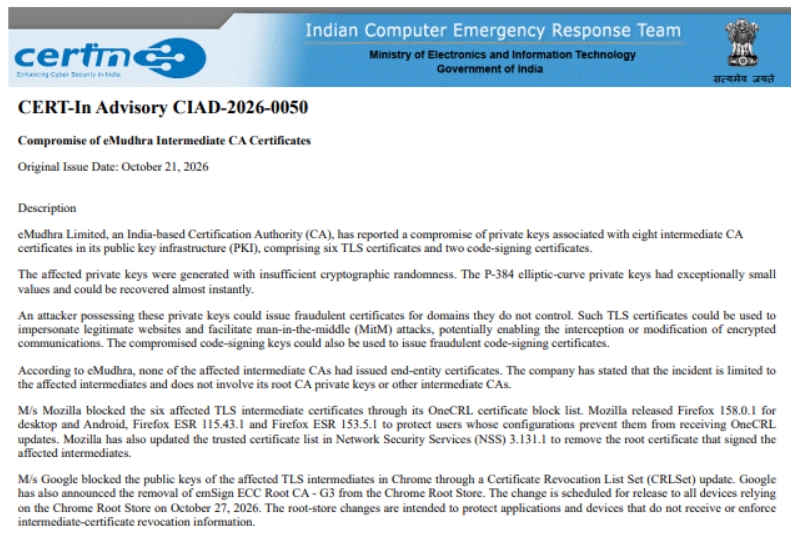
When a certificate authority’s private keys are compromised or can be recovered by an attacker, the consequences can extend beyond an individual website. Depending on the affected certificates and their permissions, attackers could potentially impersonate trusted services or undermine secure connections.
Reports concerning the eMudhra incident described weak private keys associated with intermediate certificate authorities. However, claims about the total number of affected certificates and the extent of actual exploitation should be distinguished from independently confirmed findings.
Why certificate authority security matters
A compromised certificate authority can undermine trust in the digital certificate ecosystem. Potential consequences include:
- Unauthorized issuance or misuse of digital certificates.
- Website impersonation and phishing attacks.
- Increased risks to encrypted communications.
- Browser trust warnings or certificate distrust.
- The need to replace affected certificates and keys.
Organizations should review official browser-vendor advisories, verify their certificate chains and replace affected certificates when instructed by the relevant authority.
2. SBI Customer Data Exposure Raises Privacy Concerns
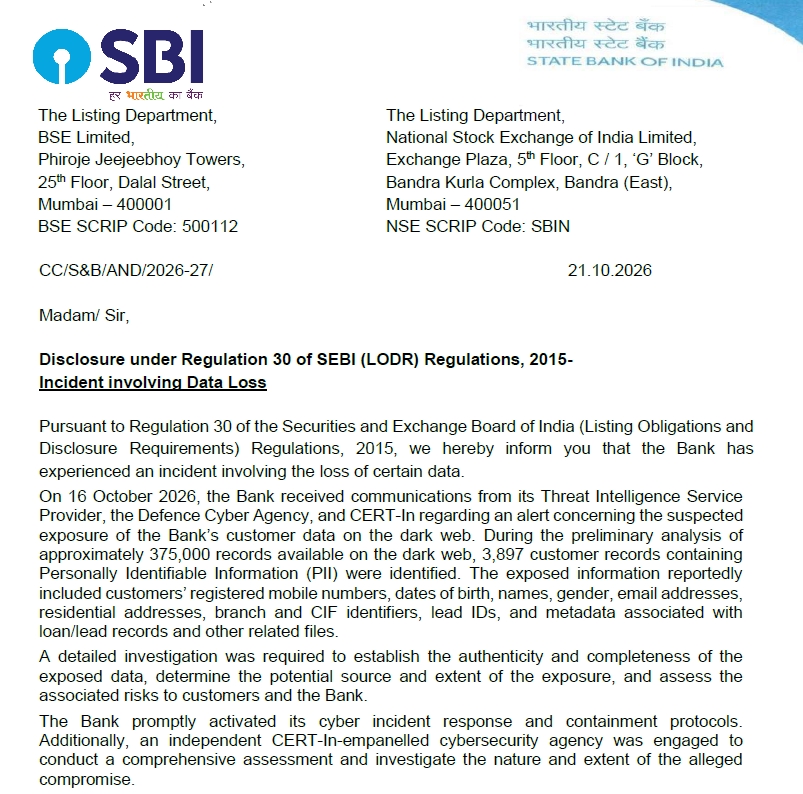
Reports involving the State Bank of India (SBI) described the discovery of customer information circulating on the dark web. The reported dataset included personal details and loan-related information associated with thousands of customers.
Financial institutions hold highly sensitive information, making them attractive targets for cybercriminals. Even when attackers do not obtain direct access to banking credentials, exposed personal data can be used to conduct convincing phishing campaigns, impersonate customers or support identity fraud.
What information can be misused?
Depending on the records exposed, attackers may attempt to exploit:
- Mobile phone numbers.
- Dates of birth and residential addresses.
- Loan and financial information.
- Customer identification details.
- Other personal information contained in financial records.
The exposure of personal data does not automatically mean that bank accounts have been accessed or that funds have been stolen. Nevertheless, affected customers should remain alert to suspicious communications.
How customers can protect themselves
Customers should never disclose OTPs, PINs, passwords or banking credentials in response to unsolicited calls or messages. They should also verify communications through official banking channels and promptly report suspicious transactions or suspected identity misuse.
Banks and other financial institutions should investigate the source of exposed records, assess the scope of the incident and follow applicable data-protection and incident-reporting requirements.
3. Alleged Rajasthan Police Data Breach
Another reported cybersecurity claim involved an alleged breach of Rajasthan Police-related data. The claims described a dataset containing identity records and mobile numbers being offered for sale.
Such allegations require careful verification. Data advertised on criminal forums may contain authentic records, outdated information, fabricated entries or information collected from unrelated sources.
Until the relevant authorities or credible independent investigators confirm the incident, the reported dataset size and attribution should be treated as allegations rather than established facts.
Why government data breaches are serious
Government databases may contain personal information that can be misused for identity fraud, targeted phishing, impersonation and other criminal activities.
Government agencies can reduce these risks through strong access controls, multi-factor authentication, network segmentation, continuous security monitoring and regular vulnerability assessments.
Incident response teams should also preserve forensic evidence and determine whether the information originated from government infrastructure or another source.
4. PHP2Shell: A Critical Remote Code Execution Risk
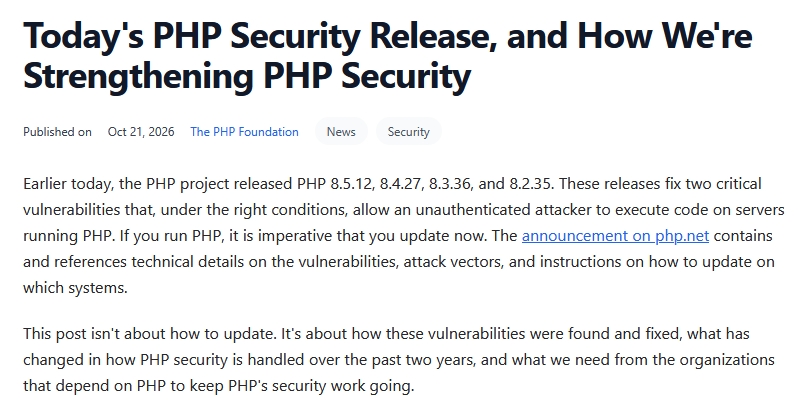
Remote code execution (RCE) vulnerabilities are among the most serious software security flaws because they can allow attackers to execute commands or code on a vulnerable system.
Reports concerning PHP2Shell described a critical vulnerability affecting PHP environments. The exact impact depends on the affected component, vulnerable configuration, software version and whether the relevant endpoint is reachable by an attacker.
An unauthenticated RCE vulnerability is particularly dangerous because an attacker may not need a legitimate account to exploit the weakness.
What can attackers do with an RCE vulnerability?
Successful exploitation may allow attackers to:
- Execute malicious commands on a server.
- Read or modify accessible application files.
- Steal application credentials and configuration secrets.
- Deploy web shells or other malicious software.
- Move laterally into connected systems.
- Use a compromised server to attack other infrastructure.
The presence of PHP, WordPress, Drupal or Laravel alone does not establish that a website is vulnerable. Administrators must identify the affected component and determine whether their deployed version and configuration are impacted.
Recommended mitigation
Administrators should consult the applicable official security advisory, install the corrected version and investigate any potentially exposed systems. Web application firewalls and restrictive network controls can provide additional protection, but they should not replace patching.
Security teams should also review web server logs for unusual requests, unexpected command execution, suspicious file creation and unexplained outbound connections.
5. GitLab Security: The Risk of Critical RCE Vulnerabilities
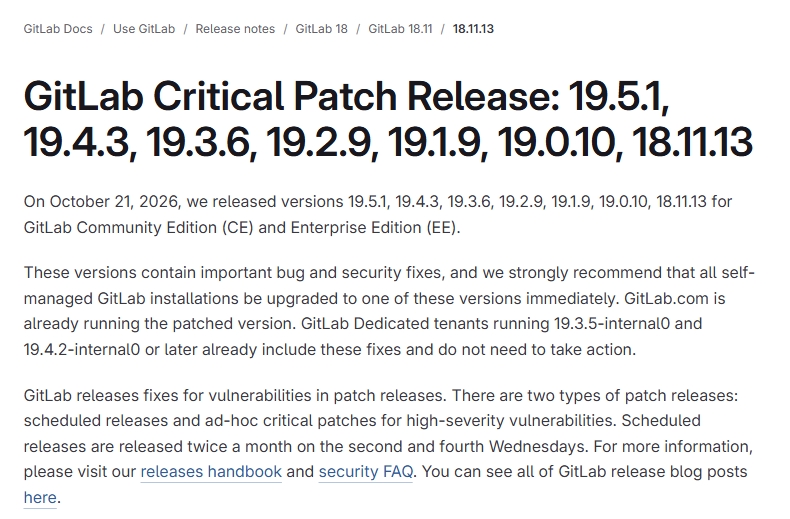
GitLab is widely used for source code management, collaboration, continuous integration and continuous deployment. A critical vulnerability in a GitLab instance can therefore affect more than a single application: it may expose source code, deployment credentials, build runners and connected infrastructure.
Claims of a maximum-severity, unauthenticated GitLab RCE should be verified against the relevant GitLab security advisory and CVE record before being treated as confirmed.
Why a GitLab compromise can have a broad impact
Development platforms often have access to sensitive assets, including:
- Source code and private repositories.
- CI/CD variables and deployment secrets.
- Access tokens and service credentials.
- Build runners and deployment environments.
- Container registries and software packages.
If an attacker compromises a development platform, they may attempt to modify source code, tamper with build artifacts or abuse deployment permissions.
Organizations should update affected GitLab installations, restrict administrative access, review audit logs and rotate credentials if exposure is suspected. CI/CD runners should use least-privilege permissions and should not share sensitive credentials unnecessarily.
6. Node.js Security Updates and Remote Code Execution Risks
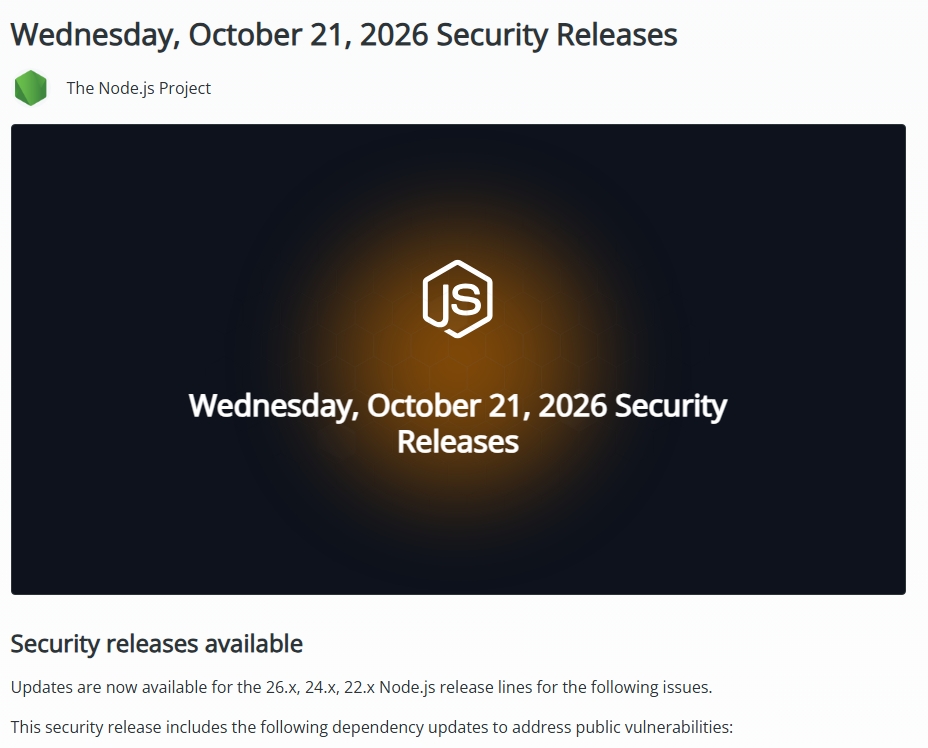
Node.js powers many web applications, APIs, backend services and developer tools. Security flaws in its runtime or bundled components can affect applications that depend on vulnerable releases.
Reports associated with the Node.js security updates described multiple vulnerabilities, including a Brotli decoder issue and TLS-related security concerns. The precise consequences depend on the individual vulnerability and the affected Node.js release.
Potential security impact
Depending on the flaw, successful exploitation may result in application crashes, memory corruption, remote code execution or weaknesses in secure communications. Applications using Node.js should not assume they are safe simply because their application code has not changed. Runtime vulnerabilities can exist independently of application-level logic.
Steps for Node.js administrators
- Check the installed Node.js version across servers, containers and development environments.
- Review the official Node.js security release notes.
- Upgrade to a patched release supported by the applicable release branch.
- Rebuild container images and redeploy affected workloads.
- Investigate crashes, suspicious child processes and unusual outbound traffic.
Teams should also verify that their dependency lockfiles and deployment pipelines consistently use approved runtime versions.
7. Railway Security Incident: Protecting Environment Variables
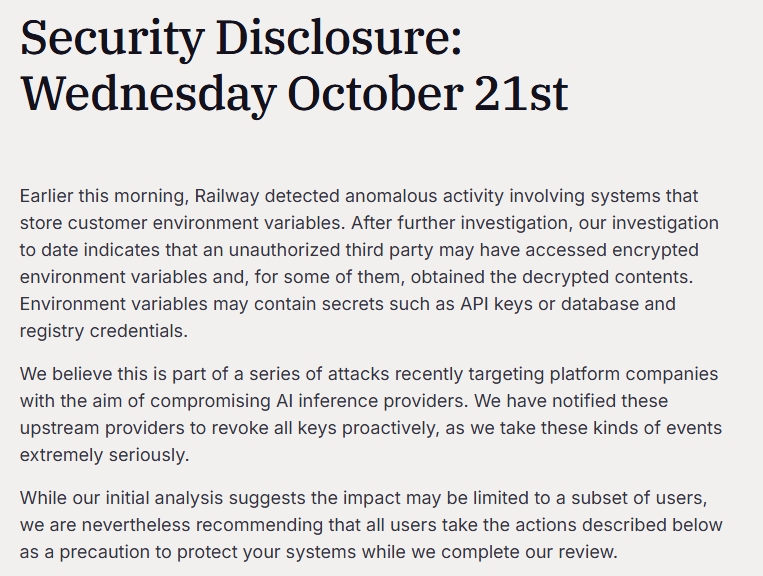
Cloud development and deployment platforms commonly store environment variables containing API keys, database passwords, authentication tokens and other secrets. Reports concerning Railway described unauthorized access involving stored environment variables and raised concerns about the exposure of sensitive credentials.
If an attacker obtains usable secrets, they may attempt to access databases, invoke external APIs, modify cloud resources or compromise connected services.
Why environment variables are sensitive
Environment variables are frequently used to configure applications without embedding credentials directly in source code. However, they remain sensitive assets and must be protected throughout their lifecycle.
A compromise involving a hosting platform can create risks for every downstream service accessible using the affected credentials.
What developers should do
- Rotate potentially exposed API keys, database passwords and access tokens.
- Revoke credentials that are no longer needed.
- Review cloud, database and API access logs for suspicious activity.
- Check whether exposed secrets had excessive permissions.
- Replace credentials in deployment configurations and secret stores.
- Verify that old credentials no longer work.
Credential rotation should include dependent services and scheduled jobs, not just the application where a secret was originally stored.
8. OpenCode Incident and AI Provider API Key Exposure
AI development tools increasingly connect to multiple model providers, including OpenAI, Anthropic and Google. These integrations frequently rely on API keys that authorize access to paid services and potentially sensitive model capabilities.
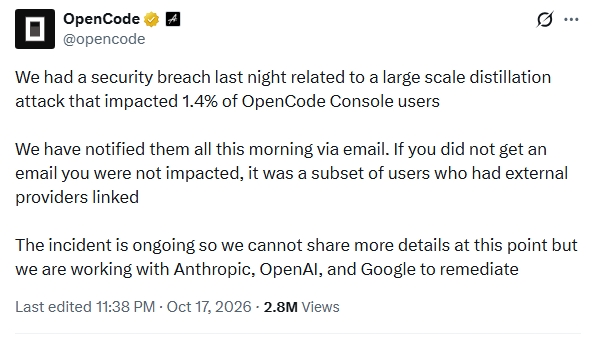
Reports about an OpenCode-related security incident described concerns about provider API keys and unauthorized use in connection with AI distillation activity.
The exact scope of any exposure should be established through official incident communications. Users should not assume that every account or provider credential was compromised.
Why API key exposure matters
An exposed AI provider API key may be abused to:
- Generate unauthorized API requests.
- Consume paid model credits.
- Access permitted provider resources.
- Exceed usage quotas and cause service disruption.
- Increase the risk of unauthorized access to connected workflows.
How to secure AI development environments
Developers should inspect their API usage dashboards for unexpected activity, revoke suspicious credentials and generate replacement keys when necessary.
API keys should be stored in approved secret-management systems rather than source code, public repositories, logs or unprotected configuration files. Usage limits, project-level restrictions and billing alerts can help reduce the impact of credential abuse.
9. LiteLLM PyPI Supply-Chain Attack
Software supply-chain attacks target the tools and dependencies organizations trust to build and operate applications. A malicious package release can be particularly dangerous because developers may install it through normal package-management workflows.
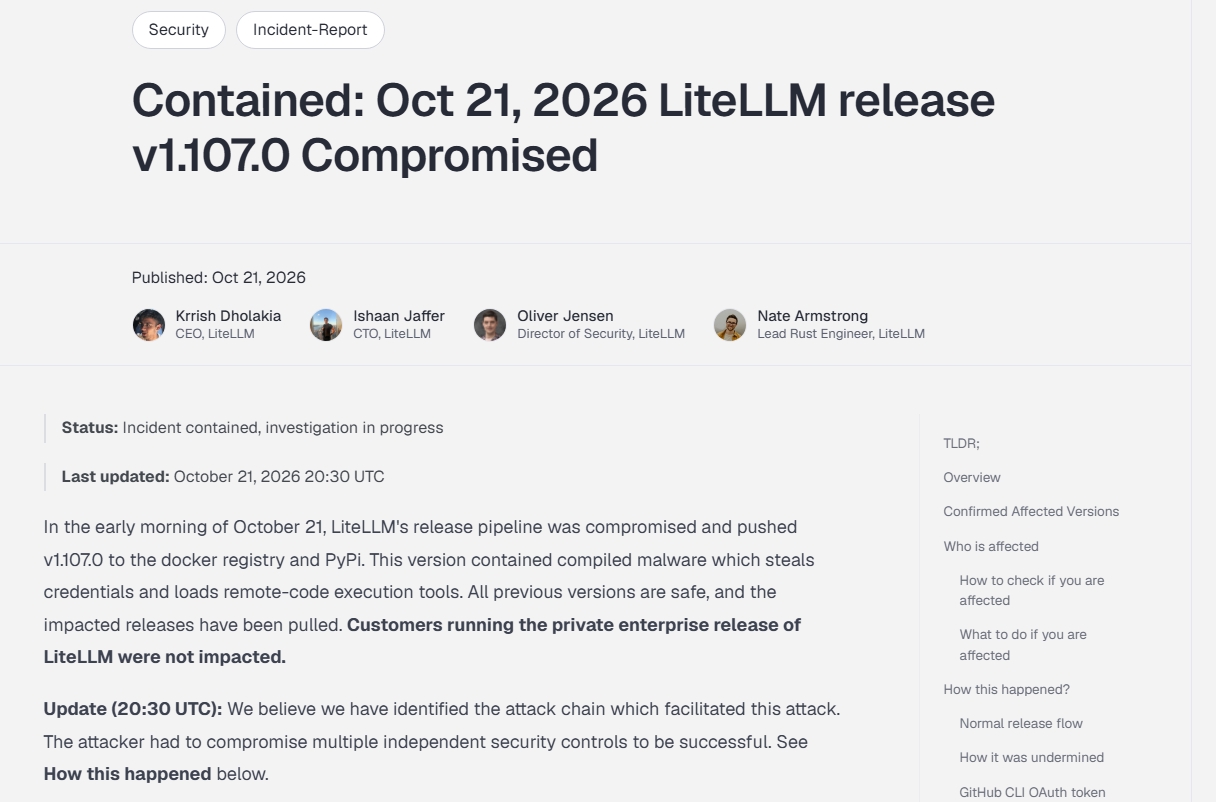
A reported LiteLLM PyPI incident involved a malicious package release identified as version 1.107.0. The reported behavior included credential theft and backdoor capabilities. This type of incident demonstrates why a package’s presence in a trusted registry does not guarantee that every published version is safe.
How malicious Python packages compromise systems
A malicious package may attempt to access:
- Environment variables.
- Cloud and AI provider API keys.
- Database credentials.
- SSH keys and other accessible secrets.
- CI/CD tokens and deployment credentials.
Depending on its permissions and execution context, the malicious code may send stolen information to external infrastructure or establish persistence.
What LiteLLM users should do
Organizations that installed or executed an affected release should follow the official incident-response guidance.
Important steps include:
- Identify the exact package versions installed during the exposure window.
- Inspect dependency lockfiles, build logs and container image digests.
- Isolate potentially compromised environments where appropriate.
- Rotate credentials accessible to the affected process.
- Rebuild environments from verified, clean dependencies.
- Investigate outbound connections and possible unauthorized access.
Simply downgrading or uninstalling a malicious package may not be sufficient if it has already stolen credentials or modified the environment.
10. Plex2Shell and Active Exploitation Concerns
Plex Media Server is used to organize and stream personal media libraries. Like any internet-accessible service, it can become a target when vulnerabilities allow unauthorized access or code execution.
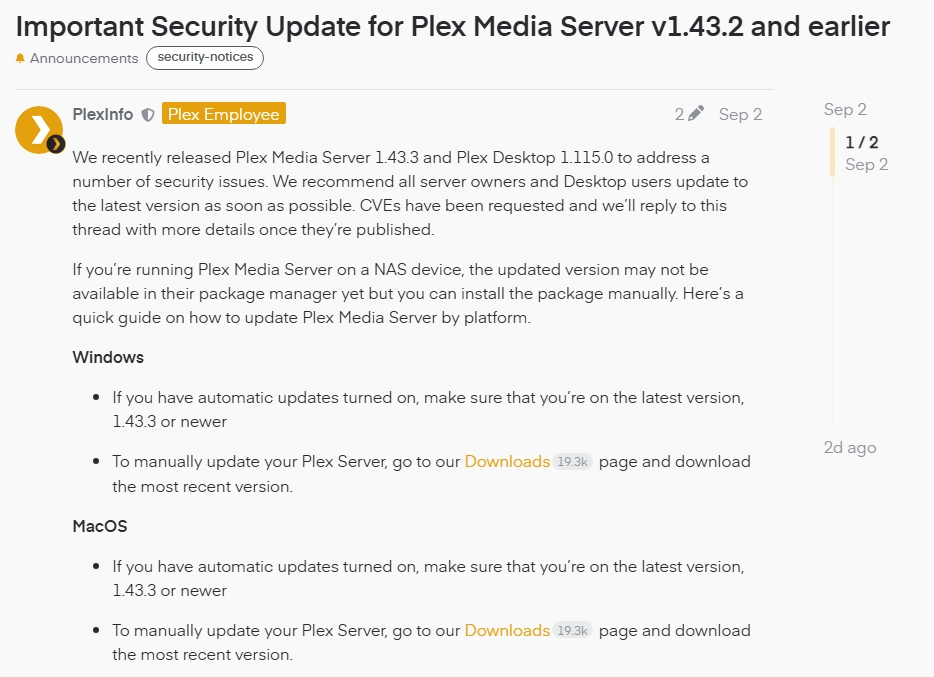
Reports involving Plex2Shell described exploitation of Plex-related vulnerabilities, with some incidents reportedly involving cryptomining activity. Claims about active exploitation and specific attacker behavior should be evaluated against vendor advisories and authoritative vulnerability records.
Why internet-facing media servers need attention
A vulnerable server can provide an entry point into a home network or business environment. If the server has excessive permissions or access to shared storage, a compromise may extend beyond the media application.
Potential consequences include unauthorized command execution, malware installation, resource abuse and access to files available to the service account.
Recommended Plex security measures
Administrators should update Plex Media Server to an unaffected version, restrict remote access where it is unnecessary and review logs for unusual authentication attempts or unexpected processes.
Where compromise is suspected, isolate the server, preserve relevant evidence and investigate its network connections before returning it to service.
How Organizations Can Respond to Multiple Cybersecurity Threats
When several vulnerabilities and security incidents emerge simultaneously, organizations need a structured process for determining which systems require immediate action. Trying to patch everything without understanding exposure can waste time, while waiting for perfect information can leave critical systems vulnerable.
The following practices help security teams prioritize their response.
1. Maintain an accurate asset inventory
Identify all internet-facing systems, software versions, containers, dependencies, development platforms and third-party services. An accurate inventory allows teams to determine which advisories are relevant to their environments.
2. Prioritize vulnerabilities by actual exposure
A critical vulnerability on an exposed production server may require faster action than the same vulnerability on an isolated test system. Consider severity, exploitation evidence, internet accessibility, business importance and available mitigations when prioritizing remediation.
3. Rotate exposed credentials
When a software supply-chain compromise or cloud platform incident may have exposed secrets, identify the credentials available to the affected environment. Revoke or rotate potentially compromised credentials and investigate their use during the relevant exposure period.
4. Strengthen SIEM monitoring
Security information and event management (SIEM) platforms can help correlate suspicious activity across endpoints, networks, servers, cloud services and applications.
Useful detection opportunities include:
- Unexpected outbound connections from application servers.
- Suspicious process creation and command execution.
- Web shell creation and modification of executable files.
- Unusual API usage or sudden increases in service consumption.
- New privileged accounts and unexpected authentication patterns.
- Changes to scheduled tasks, services or startup configurations.
- Unusual package installation activity in CI/CD environments.
- Access to sensitive credentials outside normal workflows.
These indicators should be correlated with asset inventories, vulnerability information and threat intelligence. No single indicator proves that a system has been compromised.
5. Review third-party dependencies
Software development teams should maintain dependency inventories, lock package versions where appropriate, verify package provenance and monitor official security advisories. For high-risk environments, signed artifacts, reproducible builds and controlled package registries can improve supply-chain security.
6. Prepare an incident response plan
A documented response process should define who can isolate affected systems, revoke credentials, approve emergency patches and communicate with customers or regulators. Regular exercises help teams respond more efficiently when multiple incidents occur at the same time.
Final Thoughts
The reported incidents involving eMudhra, SBI, PHP, GitLab, Node.js, Railway, OpenCode, LiteLLM and Plex illustrate the range of threats facing modern digital infrastructure.
The risks are not limited to traditional network attacks. Certificate trust, customer privacy, software dependencies, cloud credentials and AI development workflows can all become part of a broader security incident.
Organizations should verify individual claims against official advisories, identify affected assets, patch vulnerable software, rotate exposed secrets and investigate suspicious activity.
The most effective cybersecurity strategy is not to react to every alarming headline. It is to verify the threat, understand your exposure and take the right action before an attacker can exploit the weakness.
Disclaimer: Cybersecurity incidents and vulnerability information can change as investigations progress. Confirm affected versions, incident scope and remediation instructions through the relevant vendor’s official security advisory before making operational decisions.
Last Update: 22 October 2026